My employer, Aquatic Informatics, was named the 37th fastest growing technology company in
Canada and only one of three cleantech leaders on Deloitte’s
Technology Fast 50™ List. Very cool for the Vancouver software scene.

Check out my first blog post on the Aquatic Informatics blog: AQUARIUS: Where Smart Water Data Meets the SMART Tunnel
In this post, I discuss the engineering feat that is the SMART (Stormwater Management and Road Tunnel) Tunnel. It stretches 9.7 km beneath Malaysia’s capital and function both as a roadway as a storm drainage system.
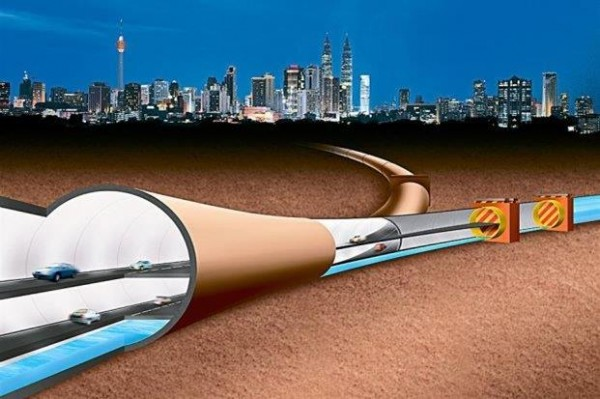
- Image Courtesy: ENTURA, Hydro Tasmania
From the post:
The “Stormwater Management And Road Tunnel” (SMART Tunnel), has been featured in many news stories and television shows such as Extreme Engineering on the Discovery Channel, Build It Bigger on the Science Channel, Megastructures on the National Geographic Channel, and Man Made Marvels on the Science Channel. The reason the Kuala Lumpur tunnel is so amazing starts with its length: it is the second longest storm drainage tunnel in Asia at 9.7 km (6.0 mi). The truly amazing aspect of the SMART tunnel is that it’s the first dual-use storm drainage and road structure in the world. The tunnel is mainly used to ease traffic congestion in Kuala Lumpur, but there is a storm drainage system under the two decks of cars. Essentially, the tunnel acts as a reservoir to decrease the peak of water flows of the Klang river and therefore mitigate the severity of floods. However, that’s not all. In the event of a bad flood, the road decks can also be used to drain the storm water away from the city. That’s right. The car levels can be completely filled with water as well!
Update: It was recently announced that a similar tunnel project is planned for Jakarta:
Jakarta Announces Plan for Integrated Tunnels to Manage Traffic and Floods
Check out Stu Hamilton’s blog post on the Aquatic Informatics website about World Water Day 2013.

“To mark World Water Day at Aquatic Informatics we watched the movie ‘Last Call at the Oasis’. In discussion about the issues raised by this movie one of our senior developers expressed surprise at the magnitude of the water footprint for everyday products.
I don’t know whether the notion of accounting for your water footprint will catch on or not. A few years ago the idea of calculating your carbon footprint got quite a bit of press and even though carbon calculators have never caught on the notion that your carbon footprint matters seemed to stick. Equating energy use with a carbon footprint is intuitive – if I turn on a light my footprint grows whereas if I walk to work my footprint shrinks.”