Showing posts with label augmented reality. Show all posts

Wednesday, January 13, 2016

I AM CARDBOARD VR Url Not Recognized Setup Error


For Christmas, I picked up a Google Cardboard viewer. It's the easiest (read: cheapest) way I know to get a virtual reality headset for home use. When I co-wrote Augmented Reality: A Practical Guide for the pragmatic programmers (in 2006), headsets for augmented reality or virtual reality were expensive and bulky.

That certainly has changed. Google cardboard devices are literally made of cardboard. There are lots of choices. I got the I AM CARDBOARD® 45mm Focal Length Virtual Reality Google Cardboard. So far, I'm impressed with the inexpensive device. Enabling clicking in the virtual user interface by moving a magnet on the side of the device is ingenious.


Unfortunately, I quickly ran into a problem with the set up. When asked to use my phone's camera to grab the QR code on the cardboard, I received the error "URL not recognized" or "Problem in parsing the Url." QR codes represent a URL and if that URL changes, they can break. The solution was to find the manufacturer's website and search for a QR code there. In this case, I found a working QR code for the I AM CARDBOARD. Now I'm looking forward to trying out more of the apps with my daughter.


Update: My daughter loved it! I shot a video of her reaction that I'm sharing with family. So cool.

BTW: from the site -- "Calibrate your VR headset using the QR code found in this listing images. To do so, open the Google Cardboard app, select "Configuration" menu option, click on "Switch viewer" and scan the QR code."

Monday, May 10, 2010

Business in Vancouver Interview about Augmented Reality

Curt Cherewayko from Business in Vancouver recently interviewed me about my book, Pragmatic Augmented Reality.

It is quite clear that Augmented Reality (AR) has caught the attention of many developers and reporters. But as I was quoted as saying in the Business in Vancouver article, people probably “won’t know the underlying technology is augmented reality. They’ll just accept that this is the way it works.”

Saturday, August 23, 2008

Augmented Reality in the Olympics

good to see that more great uses of Augmented Reality are being discovered. in the shot below, you can see Michael Phelps and company racing well ahead of the green AR world record line. football fans see this sort of technology every game, but now you can see it in swimming, javelin, and probably some other events that I haven't been fortunate enough to watch.


- click to view full size

as the US team turns, another AR element is added to show that they are leading. this one is a banner positioned and layered to appear as though it is floating on the water.


- click to view full size

Tuesday, April 15, 2008

ARTag SDK download

if you purchased the book you can download the Rev2K SDK for Windows, Linux, or MacOSX for free (for non-commercial private use that is) at the following link: http://www.artag.net/sdk_download/artag_sdk_download.php

there is Windows, Linux and OSX code in the SDK and there is more in the book specific download which is available from the AR book page on the pragmatic site: http://www.pragprog.com/titles/cfar (look for the "code" link)

Wednesday, February 27, 2008

interesting Augmented Reality

check out this video of the NTT DoCoMo U-Tsu-Shi-O-Mi robot. Augmented Reality (AR) is used to superimpose the avatar image on the robot skin.

"Japanese mobile phone operator NTT DoCoMo has released this video of their U-Tsu-Shi-O-Mi green skinned robot. When viewed through a head-mouned-display ..., a video avatar is overlaid and mapped to the robot so it looks like a real person from any angle."

Monday, January 28, 2008

AR book is out

Augmented Reality: A Practical Guide is out!

who will be the first to review it? will it be you?

the code download for the book is available on the Pragmatic book page

Thursday, January 10, 2008

CNN uses Augmented Reality

during the Iowa primary election coverage, CNN's Anderson Cooper held up a "magic pie chart." Jon Stewart showed the clumsy use of the technology on The Daily Show. it's actually an application of Augmented Reality, but the BBC was the first group (I know of) who used it for election coverage.

I haven't been able to find any images of the CNN example, so if you're reading this and you know of one, please post a comment.
update: wow, thanks to datadreamer for the quick reply.


- Anderson Cooper showing off Augmented Reality
(from http://www.flickr.com/photos/monoki/2165007234)


- Bill Gates tries out an ARTag AR system that uses a head-mounted display (our AR book uses ARTag but does not require anything other than a Windows PC and a webcam)

Mark put this short video up on YouTube, it's a good demo of what we're talking about in our book: http://www.youtube.com/watch?v=ItOtTdhDoto

this game shows a simple way of using the technology to enhance a card game experience.

Monday, January 07, 2008

augmented reality book is coming

the book that I co-wrote about augmented reality will be coming out soon.

Dr Mark Fiala, a researcher at the National Research Council of Canada, was my co-author and together we have written (what I believe is) the first book about augmented reality that is targeted at the average person. all you need is a computer, printer, and a webcam.

BTW -- you can see ARTag videos on YouTube (just search for "ARTag").


from the publishers website:

"Augmented Reality is the fusion of real and virtual reality, where computer graphics objects are blended into real footage in real-time. AR creates the illusion that virtual, computer-generated objects exist in the real world. All you need is a computer and a webcam. This book will show you how, and teach you about game development at the same time. You can run the included demos, or use the ARTag API to customize your own AR applications.

About this Book

Augmented Reality is a natural way to explore 3D objects and data, as it brings virtual objects into the real world where we live, rather than forcing us to learn how to navigate inside the computer. With video-see-through technology, AR handheld devices such as tablet PC’s, PDA’s, or camera cell phones, (or in many cases just a webcam and our standard computer monitor), you hold the device up and “see through” the display to view both the real world and the superimposed virtual object. You can move around and see the virtual object, model, animation, or game from different views as the AR system performs alignment of the real and virtual cameras automatically.

This book will introduce you to Augmented Reality (AR), provide detailed explanations of how the technology works, and provide samples for you to try on your own. Code samples using the freely downloadable ARTag software SDK in C++ and C# are included; all you need is a computer, printer, and a webcam."
- Pragmatic Publishing

Friday, August 31, 2007

Wednesday, August 01, 2007

ARTag FAQ

I'm currently working on a book about Augmented Reality (AR) for Pragmatic Publishing. the AR technology the book uses is called ARTag. it was invented by my co-author, Dr. Mark Fiala, at the National Research Council of Canada.

BTW -- you can see ARTag videos on YouTube (search for "ARTag").


- ARTag Tank Wars demo (click for full size image)


- another view showing a real hand in the frame (click for full size image)

this post is a pro-active attempt to answer some questions before the book is shipped.


General Non-Technical Questions
-----------------------------------------------------------
Q: I have a question about ARTag. who do I ask?
A: http://www.artag.net/

Q: What is ARTag?
A: It's a fiducial marker system for visual Augmented Reality. Based on numerous metrics, ARTag is widely considered to be the best AR marker system available. Refer to http://www.artag.net/ for more details.

Q: Can I use ARTag for a commercial product?
A: ARTag is provided (time bombed) for academic purposes. to use ARTag in a commercial product, you will need to get a license from the National Research Council of Canada.

Q: Do I have to use OpenGL with ARTag?
A: The current library only supports OpenGL, but other graphics systems may be supported in the future.

ARTag Technical Questions
-------------------------------------------------------
Q: How do I get at the data coming from artag_set_object_opengl_matrix()? I want to use it in my own graphics system.
A: It isn't possible to get the information from artag_set_object_opengl_matrix(). It sets the matrix internally and the data is used for subsequent rendering. In other words, the only way to get the result is to use them by supplying ARTag an image and something to augmented to it. The current library only supports OpenGL, but other graphics systems may be supported in the future.

Questions about the ARTag C# Wrapper or C# sample
-------------------------------------------------------
Q: Why does the "OpenGL only" C# sample require the ARTag library?
A: The library is only required to read the test texture (PPM format).

Thursday, June 28, 2007

Goblin XNA Augmented Reality

Goblin XNA is a project at Columbia University that aims to create a platform for developing Augmented Reality (AR), or Virtual Reality, applications with Microsoft's new XNA game development platform.

this project is particularly interesting to me because I've just finished books on XNA (XNA Game Studio Creators Guide) and AR. Goblin XNA uses the ARTag marker system, which was developed by my AR co-author Dr. Mark Fiala.

Friday, March 30, 2007

AR has arrived

according to a recent article on technologyreview.com, mobile Augmented Reality (AR) might be just around the corner. in fact, Technology Review (published by MIT review) has rated AR as one of the top ten emerging technologies of 2007.

the article highlights an effort from the Nokia Research Center in Helsinki, Finland. they are working on mobile software that will help users download information about the buildings and businesses around them. for example, after recognizing the Empire State building in the phone's camera, the user can be provided with information about tours.

AR technology is certainly mature enough to support numerous applications. the real question is whether there will be enough public demand to support AR businesses. I believe that this will happen, it's just a question of when.


- this image from the article shows the Empire State building recognized by the Nokia system

I am currently working a book about AR for Pragmatic Publishing. my co-author, Dr. Mark Fiala, has ported some of his AR demos to a mobile phone.


- this figure from my upcoming AR book shows cell phone software recognizing ARTag markers

Wednesday, November 15, 2006

quick update

wow, how time flies. I haven't written anything here in ages. the reason for this is simple. I'm working hard on the augmented reality book for pragmatic, and I have also started on a new project that will be announced soon.

Thursday, October 05, 2006

AR book screenshot

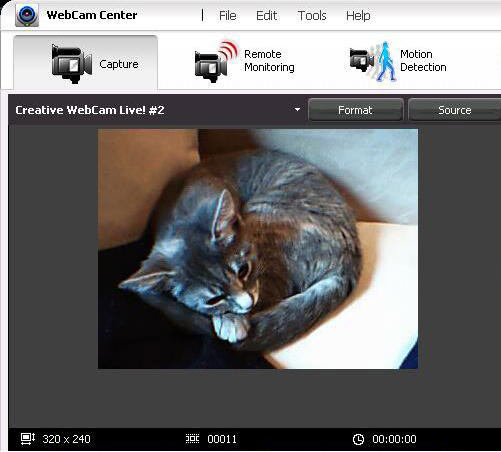
I thought I'd share this figure from the augmented reality (AR) book that I'm working on for the pragmatic bookshelf. it's in a section about setting up a webcam for AR - the little critter is a dilute calico field mouse... er, I mean kitten.


update: sadly, this image was cut :(

Sunday, April 09, 2006

pragmatic augmented reality book

after having completed my third Halo book (the black art of Halo mods for Sams), I've moved onto my next project. it's a book called Augmented Reality: A Practical Guide for the pragmatic programmers. it's a cool project and I'm excited to be working with the pragmatic folks --- if you're not familiar with them, they are responsible for the highly respected book the pragmatic programmer.

Update: the code download for the book is available on the Pragmatic book page


- draft cover for Augmented Reality @ Home (now... Augmented Reality: A Practical Guide)

Augmented Reality is the process of adding virtual objects to the real world. so unlike 'virtual reality' most of what you see is usually real.

in our book, we'll be explaining (and providing) all of the source code for an Augmented Reality "Tank Wars" game (see screenshots below). the book's download includes samples for Windows, Linux and MacOS. the applications are written in C/C++ and C#.


- ARTag Tank Wars demo (click for full size image)


- ARTag Tank Wars demo (click for full size image)

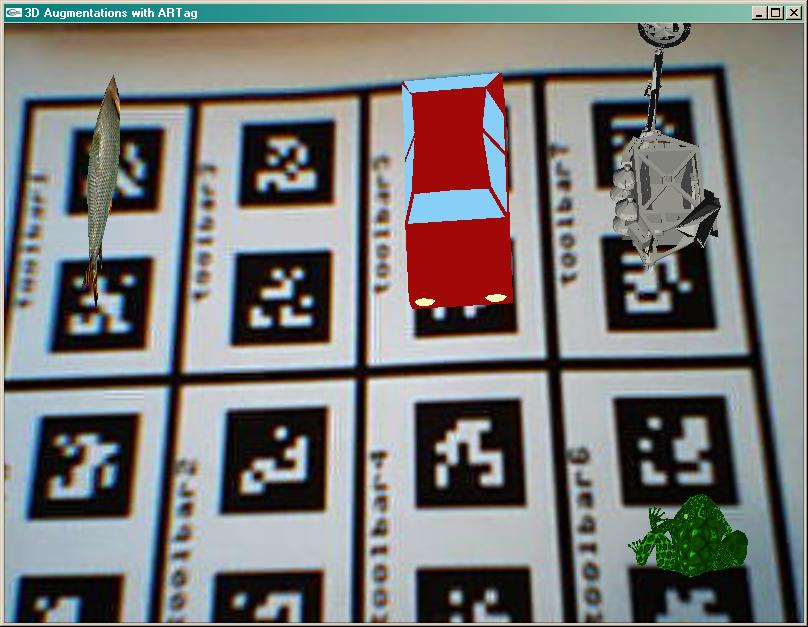
here's a quick example that I just shot on my dining room table. the piece of paper with the augmented reality tags is real and the 3D objects (e.g., the fish and car) are artificial. in order to see the virtual portion, you obviously must be looking at the scene through some sort of interface that allows the augmentation. for example, a computer monitor or a head-mounted display.


- click for full size image

and here's a 3D fish coming out of my 1939 Remington Model 5...


- click for full size image

for a better example, take a peek at this cool video of an augmented reality demonstration. you can also see ARTag videos on YouTube (search for "ARTag").

Update: I've added an ARTag FAQ post for all your ARTag questions.